China has become a major manufacturing base for Chemical Equipment, serving pharmaceutical, food, energy, and process industries worldwide. Its suppliers range from large engineering groups to specialized workshops producing reactors, heat exchangers, dryers, mixers, and filtration systems. However, “top” should not mean the largest factory or the lowest quotation. It should reflect engineering competence, traceability, quality control, after-sales service, and proven project performance.
A reliable evaluation begins with practical evidence. Review material certificates, weld procedures, pressure-test records, surface-finish reports, and customer references. Factory audits can reveal details that brochures hide, such as poor warehouse control or inconsistent welding practices. Ask whether the manufacturer understands your operating temperature, pressure, corrosion risks, cleaning method, and maintenance limits. Small details matter.
Chemical process safety expert Trevor Kletz famously said, “If you think safety is expensive, try an accident.” His warning remains relevant when selecting Chinese equipment suppliers. A cheaper vessel may create costly delays if its design files, inspection records, or spare parts are incomplete. Certifications alone are not enough. They must support real manufacturing discipline.
This guide compares leading Chinese Chemical Equipment manufacturers through product capability, export experience, technical responsiveness, and quality assurance. It also considers less visible factors, including communication gaps and customization risks. No ranking is permanently correct. Supplier performance can change with ownership, staffing, or project scale. That uncertainty deserves attention. The strongest choice is not always the most famous name, but the manufacturer that can document every critical decision.
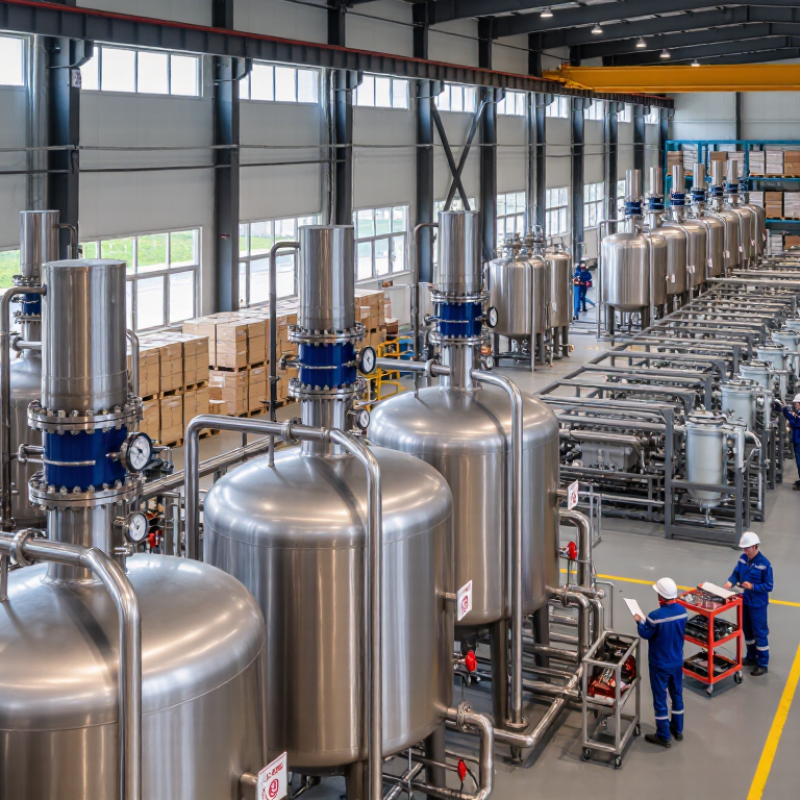
China’s Chemical Equipment Manufacturers: Why Market Scale Matters
According to Cefic, China represented about 40% of global chemical sales in 2023. This figure changes how buyers assess local equipment manufacturers. Large chemical output creates demand for reactors, heat exchangers, pressure vessels, filtration systems, and process skids. It also supports wider production experience across different capacities and operating conditions.
A reliable manufacturer should provide more than a competitive quotation. Buyers need material certificates, weld inspection records, pressure-test results, and clear equipment drawings. Stainless steel surfaces should match the process requirements. Gaskets, valves, and control components also deserve careful review. Small details can affect corrosion resistance, cleaning time, and long-term maintenance costs.
The market is not flawless. Scale does not automatically prove quality. Some suppliers communicate well before an order, then respond slowly during production. This risk makes factory audits, sample reviews, and milestone inspections valuable. Buyers should examine machining accuracy, welding areas, surface finish, and packing protection. Ask for evidence, not promises.
There is another practical concern. Fast customization can create design gaps. A vessel may meet basic specifications but still fit poorly into an existing line. Process temperature, pressure changes, installation space, and local safety rules must remain visible throughout procurement. Manufacturers with strong engineering teams usually explain these limits clearly. That honesty matters. It can prevent expensive changes after delivery.

China Top Chemical Equipment Manufacturers?
China’s leading chemical equipment manufacturers are better classified by function than factory size. The reaction segment covers glass-lined reactors, stainless-steel vessels, mixers, and continuous reactors. It serves fine chemicals, polymers, coatings, and pharmaceutical intermediates. The separation segment includes centrifuges, filtration systems, evaporators, and distillation columns. These machines often determine product purity and solvent recovery.
The third segment is heat transfer and pressure control. It includes shell-and-tube exchangers, plate exchangers, boilers, condensers, and pressure vessels. Buyers should examine thermal efficiency, weld records, inspection certificates, and fatigue calculations. The fourth segment covers storage and material handling, including tanks, silos, pumps, valves, and automated dosing units. It supports safer movement of corrosive liquids and powders. According to Cefic’s 2024 Facts and Figures, China represented about 39% of global chemical sales in 2023. That scale helps explain its broad manufacturing depth. A 2024 report from the China Petroleum and Chemical Industry Federation also highlights continued investment in intelligent production and energy efficiency. However, capacity is not uniform. Some workshops offer excellent documentation, while others still rely heavily on manual quality checks. That difference matters. Buyers should verify factory audits, pressure testing, material traceability, and after-sales response before comparing prices. Cost remains useful, but it can hide maintenance risks.
| Equipment Segment | Representative Equipment | Typical Industrial Applications | Common Materials and Construction | Typical Design Scope | Key Standards and Quality Controls |
|---|---|---|---|---|---|
| Heat Transfer Equipment |
Shell-and-tube heat exchangers Plate heat exchangers Condensers Reboilers Air-cooled heat exchangers |
Petrochemical processing, chemical synthesis, refining, fertilizer production, pharmaceutical processing, heat recovery and utility systems. |
Carbon steel, low-alloy steel, stainless steel, duplex stainless steel, nickel alloys and titanium. Common configurations include fixed-tube-sheet, U-tube and floating-head designs. |
Project-specific operating temperatures commonly range from cryogenic service to approximately 600 °C. Design pressures may range from vacuum service to more than 10 MPa, depending on the process and construction code. |
GB/T 151, GB 150, NB/T 47003.1, ASME Section VIII and TEMA are commonly referenced. Typical controls include material traceability, welding procedure qualification, radiographic or ultrasonic testing, hydrostatic testing and leak testing. |
| Pressure Vessels and Storage Equipment |
Horizontal and vertical pressure vessels Storage tanks Gas–liquid separators Reactors with jackets High-pressure cylinders and receivers |
Gas storage, liquid separation, hydrogen and industrial-gas systems, chemical feedstock storage, petrochemical processing and utility services. |
Carbon steel, stainless steel, clad steel, low-temperature steel and corrosion-resistant alloys. Fabrication commonly involves plate rolling, longitudinal and circumferential welding, nozzle integration and internal component installation. |
Common equipment designs cover atmospheric, vacuum and pressurized service. Typical design temperatures may extend from below −100 °C to approximately 500 °C, with pressure ratings determined by vessel diameter, wall thickness, material and code requirements. |
GB 150, GB/T 20801, TSG 21, ASME Section VIII and relevant China pressure-vessel supervision requirements are widely used. Controls include weld inspection, dimensional inspection, pressure testing, safety-relief-device verification and, where required, fatigue or fracture assessment. |
| Reaction and Mixing Equipment |
Agitated reactors Glass-lined reactors Stainless-steel reactors Polymerization reactors High-pressure autoclaves and mixing vessels |
Fine chemicals, pharmaceuticals, agrochemicals, polymers, coatings, resins, specialty chemicals and batch production processes. |
Stainless steel, glass-lined steel, nickel alloys, Hastelloy-type alloys and titanium are selected according to corrosion, temperature and contamination requirements. Designs may include jackets, half-pipe coils, internal coils, baffles, agitators and mechanical seals. |
Batch and continuous designs are available. Typical working temperatures range from approximately −80 °C to 300 °C, while pressure capability varies from vacuum service to high-pressure operation based on reactor geometry and code design. |
GB 150, HG/T 20569, HG/T 2371, ASME Section VIII and applicable pharmaceutical or hygienic-design requirements may be used. Quality controls include surface-finish inspection, glass-lining spark testing where applicable, agitator dynamic testing, seal testing, weld NDE and pressure or vacuum testing. |
| Separation, Drying and Solid-Handling Equipment |
Distillation columns Absorption and stripping towers Evaporators Spray and vacuum dryers Filters, centrifuges and crystallizers |
Solvent recovery, gas treatment, crystallization, wastewater treatment, salt and fertilizer production, pharmaceutical drying and powder processing. |
Carbon steel, stainless steel, duplex stainless steel, rubber-lined steel, fluoropolymer-lined steel and corrosion-resistant alloys. Equipment may incorporate trays, structured packing, demisters, heating surfaces, vacuum systems and automated discharge mechanisms. |
Separation equipment may be designed for atmospheric, vacuum or moderate-pressure service. Operating temperatures commonly range from below 0 °C to approximately 400 °C, depending on the process medium and material selection. |
GB 150, HG/T 20569, GB/T 25198, ASME Section VIII and project-specific process-design specifications are frequently applied. Controls include dimensional checks, packing or tray installation inspection, vacuum testing, weld NDE, rotating-equipment balancing and final performance verification. |
China’s top chemical equipment manufacturers should be compared by more than production scale. In 2023, reported revenue showed the strongest firms benefiting from broad portfolios, including reactors, heat exchangers, dryers, and pressure vessels. However, revenue can mislead. Some manufacturers also report engineering, maintenance, or chemical production income.
Export share offers a clearer view of international competitiveness. Firms with 30% to 50% overseas sales usually demonstrate stronger documentation, inspection systems, and shipping experience. Their equipment often includes English manuals, material certificates, and factory acceptance testing. Capacity also matters. A supplier producing hundreds of vessels annually may handle repeat orders better, while a smaller workshop may provide closer engineering attention. Bigger is not always better.
Lead time remains a practical purchasing test. Standard stainless-steel tanks may require 8 to 12 weeks, while custom alloy reactors can take 16 weeks or longer. Capacity claims should be checked against welding bays, heat-treatment facilities, and recent delivery records. Ask for photographs and inspection documents. Do not rely only on a sales spreadsheet. It is easy to compare revenue and export percentages, but harder to verify real output. In my experience, the best shortlist balances financial strength, export discipline, available capacity, and realistic lead times. A supplier promising delivery in four weeks deserves careful questioning.
China’s top chemical equipment manufacturers should treat compliance as an auditable process, not a certificate display. Paperwork is not proof. Auditors should verify the exact GB/T requirements, current revisions, and equipment category before reviewing production records. Material certificates, heat numbers, weld maps, and non-destructive testing reports must connect to each pressure boundary. Traceability matters.
ASME Section VIII audits should examine design calculations, allowable stress selection, welding procedure qualifications, welder records, inspection points, and pressure-test evidence. API requirements must match the equipment’s intended service, such as fabrication, inspection, or maintenance. Applying an API standard without confirming its scope creates false confidence. ISO 9001 adds process discipline through controlled documents, supplier evaluation, calibration records, corrective actions, and customer feedback. The ISO Survey 2022 reported 1,265,216 valid ISO 9001 certificates worldwide, but certification alone does not prove technical competence.
A useful factory audit follows one vessel from quotation to nameplate. Review the purchase specification, inspect incoming steel, observe welding controls, check dimensional records, and trace the final test report. Then sample a closed nonconformity. Was the root cause genuinely corrected? This is where many audits become weak. The approach is not perfect. Sampling can miss hidden defects, especially when production changes quickly. Independent inspectors, competent engineers, and clearly retained evidence reduce that risk. A reliable manufacturer can explain every design decision without relying on vague claims.
This scope-mapping chart compares the primary audit domains explicitly addressed by each standard. A value of 1 means the domain is directly covered by the standard; 0 means it is not the standard’s primary purpose. GB/T 19001-2016 is China’s quality-management standard aligned with ISO 9001:2015, while ASME BPVC Section VIII focuses on pressure-vessel design and construction, and API 510 focuses on in-service inspection of pressure vessels.
Choosing a chemical equipment manufacturer requires more than comparing quotations. A useful ranking begins with six measurable KPIs: safety, efficiency, cost, service, quality, and reliability.
Safety should include pressure-test records, material traceability, welding qualifications, and clear operating instructions. During factory audits, inspect guardrails, emergency systems, and maintenance access.
Efficiency can be measured through heat-transfer performance, energy use, cycle time, and production capacity. Small losses matter. A poorly designed vessel may increase heating costs every day.
Quality requires consistent dimensions, clean welds, accurate instruments, and documented inspections. One missed tolerance can delay installation.
Cost should cover the full lifecycle, not only the purchase price. Include transport, installation, spare parts, utilities, training, and planned shutdowns. A cheaper unit may become expensive after repeated repairs.
Reliability is reflected in uptime, component durability, warranty terms, and failure records. Ask for evidence from comparable projects, not polished promises.
Service deserves its own score. Measure response time, technical support, commissioning assistance, spare-part availability, and communication during delays.
A practical scorecard can assign weighted points to each KPI. Safety and reliability may deserve greater weight than short-term savings. Still, the weighting should match the plant’s process risks and operating conditions. No scorecard is perfect. Supplier data can be incomplete, and reference projects may not match your process. Review assumptions with engineers, operators, and maintenance teams before selecting a manufacturer. Calibration records and clear acceptance tests make the final ranking more trustworthy.