Inquiry
Form loading...

Who Are the Top Chromatography Column Manufacturers in China?

China’s chromatography industry serves analytical laboratories, pharmaceutical research, food testing, and industrial quality control. When comparing a Chromatography Column manufacturer, buyers should look beyond price and polished catalog claims. Stationary-phase chemistry, particle size, pore size, column dimensions, and pressure limits can all affect separation performance. Batch consistency matters, too. So do fittings, documentation, and access to technical support when a method needs adjustment. Small details matter.

This guide introduces prominent Chinese manufacturers and the products and capabilities they publicly describe. It also offers practical questions to ask before choosing a supplier: Can the company provide clear specifications? Are application data available for relevant samples? How are quality checks handled? A brochure cannot answer everything. Independent testing and direct technical discussions may reveal differences that product pages leave out. That takes time, and comparisons are not always straightforward.

No single manufacturer is the best fit for every laboratory. A research group developing a new method may value customization, while a routine testing lab may prioritize dependable supply and repeatable results. Company offerings and market information can change, so verify current details directly with each manufacturer. The following overview is a starting point, not a substitute for evaluating a column under your own operating conditions. Some claims can be difficult to compare. That deserves a closer look.
Who Are the Top Chromatography Column Manufacturers in China?

What Chromatography Columns Are and How They Are Classified

A chromatography column is a tube packed with a stationary phase. As a sample moves through it with a mobile phase, its components travel at different rates and separate. The column is not just a container: particle size, pore structure, and packing quality affect pressure, resolution, and repeatability. Small differences matter.

Columns can be classified by separation mode, including reversed-phase, normal-phase, ion-exchange, size-exclusion, and affinity chromatography. They also differ by format and scale: narrow-bore and analytical columns serve small samples, while preparative columns handle larger loads. Materials range from silica-based particles to polymeric media. These categories overlap; a column may be both preparative and ion-exchange, so labels alone do not guarantee performance.

Industry reports help explain the demand for specialized products. Grand View Research valued the global chromatography market at about US$10.1 billion in 2023 and projected growth through 2030. That broad market figure includes more than columns, so it should not be treated as a column-sales estimate. For buyers comparing Chinese manufacturers, practical checks include stated operating pressure, particle-size distribution, batch consistency, and compatibility with the intended solvent. A neat specification sheet is useful, but real sample testing remains essential. That part is easy to underestimate.


How China's Chromatography Column Industry Is Structured

China’s chromatography column industry is a layered supply network, not a single group of interchangeable factories. Some companies make column hardware, such as stainless-steel tubes, end fittings, and packing beds. Others focus on stationary phases, surface treatment, or analytical instruments. A smaller manufacturer may buy media from a specialist and concentrate on machining, packing, and testing. The picture is not perfectly neat.

Production often depends on close coordination. Particle size, pore structure, and surface chemistry affect retention and peak shape; packing consistency affects flow and efficiency. A finished column therefore needs more than a polished tube. Manufacturers typically check dimensions, pressure performance, and separation results against defined procedures. Quality can still vary between product lines, so buyers often compare test data and application support rather than relying on broad claims.

The market also includes distributors, contract producers, university laboratories, and instrument-service teams. These groups help connect domestic manufacturing with different laboratory needs, from routine quality control to method development. Regional clusters can support access to machining and technical suppliers, though the industry is not uniform across China. Some producers compete on customized formats; others focus on repeatable standard columns. That distinction matters, and it is easy to overlook.

Who Are the Top Chromatography Column Manufacturers in China? — How China's Chromatography Column Industry Is Structured

Industry Segment Typical Products Common Applications Key Manufacturing Capabilities Role in the Industry
Analytical liquid chromatography columns Packed columns for reversed-phase, normal-phase, ion-exchange, and size-exclusion chromatography Pharmaceutical analysis, chemical testing, food testing, and environmental laboratories Packing particle selection, column hardware production, slurry packing, and performance testing A core segment serving routine laboratory analysis and method development
Preparative liquid chromatography columns Larger-bore packed columns designed for higher sample loads and product purification Purification of pharmaceutical intermediates, fine chemicals, natural products, and research compounds Large-column packing, pressure-resistant hardware, scale-up support, and batch consistency control Supports purification workflows that transfer separation methods from laboratory scale toward production
Gas chromatography columns Capillary columns with stationary-phase coatings, as well as packed GC columns Petrochemical testing, residual-solvent analysis, food testing, and volatile-compound analysis Capillary tubing preparation, stationary-phase coating, conditioning, and chromatographic quality testing Serves laboratories analyzing volatile and semi-volatile compounds
Ion chromatography columns Ion-exchange separation columns for anion and cation analysis Water-quality monitoring, environmental testing, food analysis, and industrial process control Ion-exchange chemistry, resin or particle preparation, column packing, and separation-performance evaluation Addresses applications where inorganic ions and small ionic species must be separated
Biochromatography columns Columns packed with affinity, ion-exchange, hydrophobic-interaction, or size-exclusion media Protein purification, biomolecule characterization, and biopharmaceutical process development Biocompatible materials, low-nonspecific-binding surfaces, media handling, and pressure-flow testing Serves biotechnology and biopharmaceutical research and purification workflows
Column and separation-media suppliers Finished columns, bulk packing materials, or both Laboratory analysis, method development, and customer-specific purification processes Some producers integrate media preparation and column packing; others focus on one stage of the supply chain Creates a mix of integrated manufacturers and specialized component suppliers
OEM and contract manufacturing Columns produced to customer specifications, including private-label or customized formats Instrument makers, distributors, laboratory suppliers, and specialized analytical businesses Specification control, repeatable packing, documentation, and production to agreed requirements Connects component production with equipment and laboratory-supply channels

Industry-structure note: The categories above describe product and manufacturing segments, not a ranked list of companies. Product availability and technical specifications vary by manufacturer and column application.

Criteria for Identifying Leading Chromatography Column Manufacturers

Who Are the Top Chromatography Column Manufacturers in China?

Criteria for Identifying Leading Chromatography Column Manufacturers

A capable manufacturer should show consistent control over column dimensions, packing quality, and connection tolerances. Ask how each batch is inspected, not just whether it passes quality checks. Reliable records may include test conditions, pressure limits, and material traceability. These details help buyers compare products for analytical or preparative workflows. Small variations matter. A poorly packed bed can cause uneven flow, broadened peaks, or inconsistent retention times.

Look for application support grounded in practical testing. A knowledgeable team should ask about sample properties, mobile phases, operating pressure, and instrument fittings before recommending a column. Request relevant performance data and clarify how it was generated. For a fair comparison, use the same method and sample conditions across candidate columns. Service also matters: clear troubleshooting guidance can save time when backpressure rises or peak shape changes. Still, brochures rarely reveal everything. I would verify claims with a small evaluation rather than rely on polished specifications alone.

Tips: Check batch documentation, inspect fittings, and confirm pressure compatibility before purchase. Keep test conditions consistent. One caveat: even careful screening cannot guarantee identical results across different instruments or laboratories.

Notable Chromatography Column Manufacturers in China

China’s notable chromatography-column manufacturers are best assessed by engineering depth, not by polished catalogs alone. Strong suppliers document column dimensions, stationary-phase chemistry, particle-size range, pressure limits, and connection types. These details affect whether a column fits an existing system and performs consistently across runs. Small details matter. Ask how batches are checked and whether the supplier can provide test data or application guidance. Clear answers are more useful than broad claims about efficiency.

Manufacturers may specialize in analytical, preparative, or specialized columns, so the right choice depends on sample volume and separation goals. For example, a laboratory comparing closely related compounds may prioritize peak shape and repeatability, while a production team may focus on throughput and service life. Request a sample column when practical, then evaluate it with your own method and representative samples. Fit is not everything. Documentation, responsive technical support, and realistic performance expectations also count. One caution: published results may not transfer directly between instruments, solvents, and operating conditions. A careful trial can reveal limitations that a specification sheet misses.

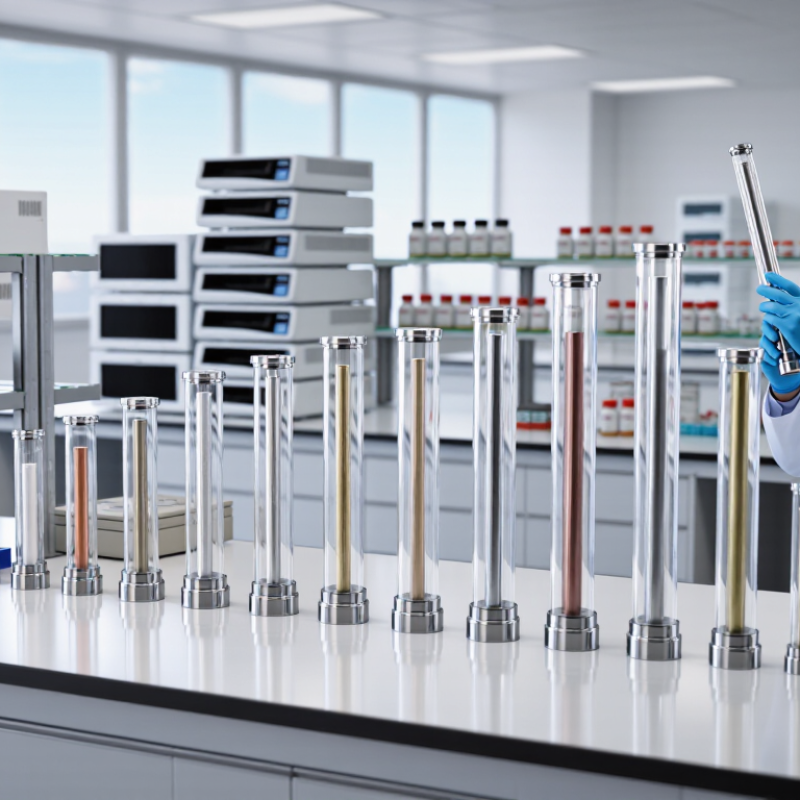
Common Analytical HPLC Column Lengths

Representative column lengths commonly available for analytical HPLC. This chart shows product specifications, not manufacturer rankings or market share.

Column length is one specification to compare when evaluating chromatography columns; the appropriate choice depends on the method and separation needs.

How Column Types Serve Different Analytical Applications

Chromatography columns are not interchangeable; their chemistry determines what they separate well. Reversed-phase columns, often packed with hydrophobic particles, help analysts resolve many small molecules in pharmaceutical and food samples. Ion-exchange columns separate charged compounds, while size-exclusion columns sort molecules by size. Affinity columns use selective binding, making them useful for isolating particular proteins.

Different jobs. Different surfaces.

Gas chromatography columns suit volatile, heat-stable compounds, such as aroma chemicals and residual solvents. In liquid chromatography, particle size, pore structure, and column length affect resolution and operating pressure. A 2023 Grand View Research report estimated the global chromatography market at about US$10.8 billion, reflecting broad demand across pharmaceutical, environmental, and food testing. This figure covers chromatography overall, not columns alone. That distinction matters when comparing market claims.

Tips: Match the stationary phase to the sample’s polarity, charge, and molecular size. Check the method’s pH and pressure limits before choosing a column. Record temperature and solvent conditions; small changes can shift retention times. One caveat: the “best” column can still perform poorly when the sample is dirty or the method is underdeveloped. Recheck the basics.